

Communication Management
Corporate Communications
In this course unit, you set up a communication agency with a few fellow students, of which you form the Management Team together and which will function as a real agency during the course unit The Agency. You decide together on the mission, vision, values, organizational culture, employer brand, etc. of your communication agency. You design a communication strategy with appropriate communication tools (at least a website) that appeals to potential applicants so that you can select and recruit the right employees (first and second year students).
The following topics are covered: Employer branding and HR, Internal communication (change communication), Interpersonal skills, CSR, Content marketing, Storytelling, Conversation management.
Evaluation: 70% portfolio, 30% written exam (tbc)
5
Communication and Innovation
In this course module of 4 weeks “Communication & Innovation”, students learn to critically reflect on (technological) innovations that will have an impact on the future of communication. Based on an analysis of the concept of “technology,” students learn to think carefully about this impact and work with examples of emerging communication technologies, such as spatial computing, Augmented & Virtual Reality,... The main objective of this course is to learn about the technological developments - such as AI, VR & AR - that will have an impact on the future of communication and to better understand critical issues involved and employ them in their strategies.
Following objectives will be achieved at beginners level: understand the possible future applications of those technologies and their ethical implications, use scientific materials to reflect on the technologies and their impact, understand the basic principles of technology, understand the main theories and frameworks of philosophy of technology.
Evaluation: 100% written exam
4
Digital Skills 3
In this course you will learn to build your own website using existing ‘content management systems’ (CMS), without any technical prior knowledge. You will discover how to build pages and optimise them for SEO. Your Outlook skills are taken to the next level by advanced calendar and task management. You will be introduced to analytics platforms such as Google, Meta, LinkedIn and TikTok Insights. You learn to interpret the data from these platforms and use it to make strategic decisions based on facts. You get those facts from the numbers. You will learn how to create advanced reports in Excel and use them to perform statistical analysis. You learn to integrate tools such as CMS, Outlook and analysis platforms for a seamless workflow. You will optimise processes, manage content strategically and make data-driven choices that make a difference.
Evaluation: Competence test 65% and workpiece 35%
Extra cost for Adobe package: €110,39
3
Professional Project: The Agency 3
In this intensive 6 weeks project you act as manager of a communication agency composed of fellow students from lower study years. Together you will be briefed by a real client on a communication challenge they face.
You develop your own vision and agreements on how your agency should run optimally. With your team you will tackle this challenge – coached by a lecturer - as a real communication agency would do: conduct the necessary research, draw conclusions, develop a realistic communication plan including budget. As management of your agency you are also responsible for team spirit and planning.
Evaluation: Observation 60%, paper 20%, presentation (to client) 20%
6
Current Affairs and Critical Thinking
In this course, you will actively follow socio-economic and political current events. Based on what appears in the media, you will engage in discussions with your lecturer and fellow students on current issues of national and/or international significance. You are expected to stay informed about ongoing developments related to the topics covered.
In addition to keeping up with general news, you will also track developments within the communication field itself—such as social trends, media campaigns, innovations in media and marketing, and relevant awards and recognitions. The accompanying critical thinking sessions focus on developing your analytical and reasoning skills. You will learn to distinguish facts from opinions, to reason logically, and to recognize framing and media bias. You will critically assess digital sources and learn how to analyse visual material used in news reports.
Particular attention is given to the responsible use and potential misuse of images and data in the media. You will also learn how to apply AI tools and digital research techniques to verify the credibility of journalistic and communication-related information. Finally, the course strengthens your ability to construct well-founded, rational arguments and to present your ideas in a professional and knowledgeable manner.
Evaluation: workpiece 50%, written evaluation 50% (tbc)
3
Digital Content
In the Digital Content course, you'll learn what opportunities there are to manage and create content for online media. We look at the whole picture of Content Management: from planning over creation to the analysis of the results. Moreover, we cover the whole range of possible content types: text, image, audio and video, with the necessary tools to do so.
Evaluation: 100% portfolio
3
Cultuur BXL Culture 3
In the Culture BXL Culture course, we explore the world of visual arts, architecture and performing arts. You will become familiar with the cultural offerings in Brussels. The history of the city of Brussels will also be covered. Through lectures, guest lectures, site visits and assignments, you will enrich your cultural knowledge. You will learn about information channels for staying informed about current cultural events, cultural trends and cultural policy.
Evaluation: 100% portfolio with oral explanations.
Extra cost for visits: €40
3
Professional English 3
Writing and speaking skills, e.g. arguing, summarizing and paraphrasing with focus on reaching the target group, giving feedback, doing short presentations, writing a paper based on desk and field research in English; Reading and listening skills: consulting, critically evaluating and applying English-language spoken and written sources of information. Vocabulary: General vocabulary with special attention to communication-related topics and topics related to the E.U., mainly in self-study. In terms of professional subject content is also offered the focus is on EU Communication. You acquire an understanding of the bottlenecks of public communication in the context of the European Union. Specifically, you examine the external communications of a European institution/organization through desk and field research.
Evaluation: portfolio 70%, workpiece 30% (tbc)
3
Survival Dutch
The aim of the "Survival Dutch" course is to master the basics of the Dutch language, both written and spoken. Starting from everyday situations, you will learn the necessary grammar and vocabulary in order to function in a Dutch speaking environment.
We strongly recommend incoming students to participate in the Survival Dutch course, organized prior to the start of the semester.
3
Presentation Skills
More information coming soon!
3
Perspectives on Social & Spatial Justice
Students gain knowledge and an understanding of the complexities of social and spatial justice through lectures, external activities and working lectures. This promotes their global citizenship and critical attitude towards social issues. In doing so, they explore themes from a rather theoretical point of view.
6
Co-Create Labs: Skills for Change
The course component focuses on developing transdisciplinary skills through hands-on activities and external visits or workshops. Students learn the added value of interdisciplinarity and how to collaborate on innovative solutions from different disciplines. They also explore the concept of transdisciplinarity and how it can be translated research-wise. Therefore it includes strengthening the research competences of (international) students from an interdisciplinary point of view.
6
Professional Practice and Impact: Internship for Fair Futures
Students gain practical experience through workplace learning and integrate together with fellow students their ‘transdisciplinary’ research in practice, supported by coaching and working lectures. This fosters their entrepreneurial spirit and ability to work in diverse teams and develop innovative solutions.
18
Professional Project: Het Bureau
In this intensive 6 weeks project you act as manager of a communication agency composed of fellow students from lower study years. Together you will be briefed by a real client on a communication challenge they face.
You develop your own vision and agreements on how your agency should run optimally. With your team you will tackle this challenge – coached by a lecturer - as a real communication agency would do: conduct the necessary research, draw conclusions, develop a realistic communication plan including budget. As management of your agency you are also responsible for team spirit and planning.
6
Communicatiecase uit persoonlijk engagement
More information coming soon!
3
Corporate Communicatie
In this course unit, you set up a communication agency with a few fellow students, of which you form the Management Team together and which will function as a real agency during the course unit The Agency. You decide together on the mission, vision, values, organizational culture, employer brand, etc. of your communication agency. You design a communication strategy with appropriate communication tools (at least a website) that appeals to potential applicants so that you can select and recruit the right employees (first and second year students).
The following topics are covered: Employer branding and HR, Internal communication (change communication), Interpersonal skills, CSR, Content marketing, Storytelling, Conversation management.
Evaluation: 70% portfolio, 30% written exam (tbc)
5
Digitale vaardigheden
In this course you will learn to build your own website using existing ‘content management systems’ (CMS), without any technical prior knowledge. You will discover how to build pages and optimise them for SEO. Your Outlook skills are taken to the next level by advanced calendar and task management. You will be introduced to analytics platforms such as Google, Meta, LinkedIn and TikTok Insights. You learn to interpret the data from these platforms and use it to make strategic decisions based on facts. You get those facts from the numbers. You will learn how to create advanced reports in Excel and use them to perform statistical analysis. You learn to integrate tools such as CMS, Outlook and analysis platforms for a seamless workflow. You will optimise processes, manage content strategically and make data-driven choices that make a difference.
Evaluation: Competence test 65% and workpiece 35%
Extra cost for Adobe package: €110,39
3
Actualiteit & Kritisch Denken
In this course, you will actively follow socio-economic and political current events. Based on what appears in the media, you will engage in discussions with your lecturer and fellow students on current issues of national and/or international significance. You are expected to stay informed about ongoing developments related to the topics covered.
In addition to keeping up with general news, you will also track developments within the communication field itself—such as social trends, media campaigns, innovations in media and marketing, and relevant awards and recognitions. The accompanying critical thinking sessions focus on developing your analytical and reasoning skills. You will learn to distinguish facts from opinions, to reason logically, and to recognize framing and media bias. You will critically assess digital sources and learn how to analyse visual material used in news reports.
Particular attention is given to the responsible use and potential misuse of images and data in the media. You will also learn how to apply AI tools and digital research techniques to verify the credibility of journalistic and communication-related information. Finally, the course strengthens your ability to construct well-founded, rational arguments and to present your ideas in a professional and knowledgeable manner.
Evaluation: workpiece 50%, written evaluation 50% (tbc)
3
Social & Spatial Justice
Students gain knowledge and an understanding of the complexities of social and spatial justice through lectures, external activities and working lectures. This promotes their global citizenship and critical attitude towards social issues. In doing so, they explore themes from a rather theoretical point of view.
6
Skills lab: Exploring Transdisciplinarity
The course component focuses on developing transdisciplinary skills through hands-on activities and external visits or workshops. Students learn the added value of interdisciplinarity and how to collaborate on innovative solutions from different disciplines. They also explore the concept of transdisciplinarity and how it can be translated research-wise. Therefore it includes strengthening the research competences of (international) students from an interdisciplinary point of view.
6
Internship: Trandisciplinary Research into Practice
Students gain practical experience through workplace learning and integrate together with fellow students their ‘transdisciplinary’ research in practice, supported by coaching and working lectures. This fosters their entrepreneurial spirit and ability to work in diverse teams and develop innovative solutions.
18
Campus Bloemenhof & Kanal
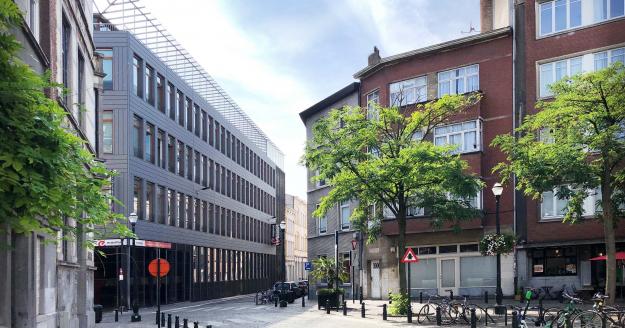
Campus Bloemenhof
Courses for this programme can be held at both the Bloemenhof campus and the Kanal campus.
Campus Bloemenhof is located in the city centre of Brussels. It is on the charming Bloemenhofplein, near the Dansaert district. The square looks particularly picturesque and dates back to the Middle Ages (Zespenningenstraat used to be one of the city gates where tolls were collected).
The biggest asset of this campus: the large roof terrace where you can have lunch and enjoy the beautiful view. It is rightly the showpiece of this campus. The city centre with its shops, restaurants and historic buildings is within walking distance.
Address
Zespenningenstraat 70
1000 Brussels
Find the Campus on Google Maps.
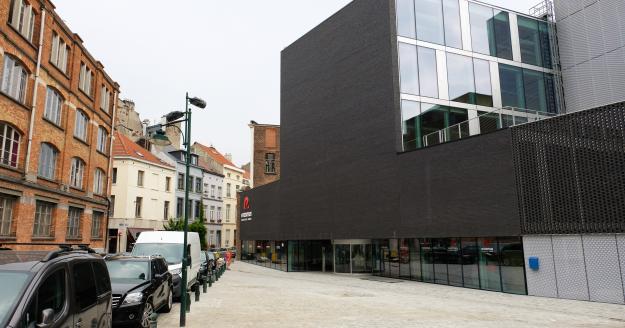
Campus Kanal
Courses for this programme can be held at both the Bloemenhof campus and the Kanal campus.
Campus Kanal is centrally located and easily accessible by bus, train, metro and bicycle. Located near the canal and in the Dansaert district, this campus is part of one of the hippest neighbourhoods in Brussels. On this new campus, we are committed to working closely with the neighbourhood, both in terms of lunch spots for students and activities with the surrounding schools.
Campus Kanal is an environment where learning can take place in a variety of locations, at a variety of times and in a variety of forms. In the building you will find modular classrooms, practical classrooms (e.g. a hair and beauty salon), an outdoor classroom and learning spaces where students and teachers can plan (in)formal learning moments.
Address
Slotstraat 28
1000 Brussel
Find the Campus on Google Maps.
Contact
Address
Erasmushogeschool Brussel
Campus Bloemenhof
Zespenningenstraat 70, 1000 Brussels
Campus Kanal
Slotstraat 28, 1000 Brussel
Contact for Erasmus students
Erasmus Coordinators Communication: ellen.thielemans@ehb.be and didier.van.ghyseghem@ehb.be
International Office: international.office@ehb.be
International Office - Coordinator for incoming students: karen.laleeuwe@ehb.be